Tuesday, February 22, 2011

Fear Knows No Sense: The Spiral Staircase

This is an EXCELLENT old black and white suspense thriller. It tells the story of young psycho-somatically mute woman named Helen who lives in a small New England town around 1915. There have been several Murders in the town, each victim a young woman with some sort of disability ( a bad leg, "mentally impaired, blind, etc.)people fear for Helen’s safety after yet another “afflicted” woman is found dead, but Helen is determined to not be afraid. She works at a huge, old, Victorian house helping take care of the doddering, bedridden widow, Mrs. Warren. (Ethel Barrymore) Helen is very devoted to keeping Mrs. Warren Company and helping her through out the day. She is also one of the few people Mrs. Warren is truly fond of. Mrs. Warren was a very strong independent woman in her youth, enjoying hunting and camping, and feels embarrassed of her bedridden state, making her irritable and grumpy(er than usual) (Again, Helen is the only person she trusts enough to talk about this with.)
Mrs. Warren tends to ramble in and out of coherency, and during these rambling moments she warns Helen to go far away, to stay somewhere safe away from the murders.  However, Helen being the strong character she is, decides to stay and help. That night, there is a bad storm, and it seems that someone starts toying with the people in the house. This includes Mrs. Warren’s two sons, one a studious professor and the other a free floating playboy, A housekeeper and her husband the handyman, and the professor’s secretary. One of these people is diabolically sneaking around the house, hiding medicines, playing with the lights, and spying on Helen from a distance. After someone disappears, it becomes clear to Helen that someone is after her, and she must defend herself in silence.
During all of this the big question is how do you call for help when you can't speak, and who do you call to when no one can be trusted? Helen is constantly cautious and during the big climax, uses the killer’s view of her as a helpless criminal to get dangerously close to the killer to end it all. The whole plot builds up with a suspenseful confrontation that completely surprised me when I first saw it.
            This is one of my favorite old thriller movies. The acting is excellent. Dorothy McGuire and Ethel Barrymore really steal the show in their performances. The rest of the cast is just as good, but something about those two really drives the movie. The whole mute plot heightens the suspense tastefully, and is far from a gimmick. The cinematography and directing is excellent and sets the mood for every scene and environment perfectly. A few scenes that really stand out are the scenes when Helen first gets to the mansion in the pouring rain and the killer is watching her about to try and make a move in the shadows. For the most part, the movie has aged well over the years, (it being first released in 1946,) but the soundtrack stick out like a sore thumb. There’s a definite overuse of the Theremin, but you basically tune it out after a while. If you like old movies, especially ones like Laura,(1944) (which I already reviewed in my “rough week’ post, if you haven’t read it, go do it now, it’s a great movie.) give this one a shot. You’ll probably love it.

Peace out and geek out,
Mikeke352

Monday, February 21, 2011

Fear Knows no Sense

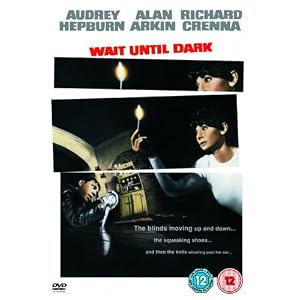
Recently, I was digging through some DVD’s at this awesome store that sells used and new DVD’s, CD’s, and video games, when I came across two old thriller movies that I absolutely adore, Wait Until Dark, and The Spiral Staircase. After stumbling upon these less-then-widely-known gems, I thought, why not talk about go over each of them a bit for my next blog entry.
Both movies are not only notable for their masterful uses of suspense, but because both films have handicapped protagonists that have an inner power and determination that transcends their perceived helplessness. Both struggle with and ultimately use their disabilities to their advantage at least for a portion of the movie. in Wait Until Dark, the protagonist uses her heightened senses due to blindness to help figure out the truth behind a dangerous conman. In The Spiral Staircase, a period piece set in the early 1900’s a Psycho-somatically mute woman, (meaning the cause for her muteness is mental,) uses the acknowledgment that she can’t call for help to get close enough to trouble to stop it.

The first movie, the 1967 classic, Wait until Dark is new to me. It stars Audrey Hepburn as Susy, a recently blinded woman who is still learning to live without sight. Her husband, a photographer, comes into possession of a doll (unknowingly,) stuffed with heroin during a trip, and it it’s not long before the psychotic Mr. Roat (who was expecting to be delivered the doll in the first place,) tracks it down and hires two con men to help him with an elaborate plan to get it back. What they don’t know is that Susy misplaced the doll and it was stolen by the little girl that lives upstairs complicating things further.
After luring her husband away for an overnight photo shoot, the three crooks begin an elaborate hoax to try and make Susy hand over the doll. The three men come and go into her apartment, trying to trick the poor blind woman into thinking her husband had an affair, then murdered his mistress, and that the doll is evidence. The two con men each play consistent roles in the plot, one pretends to be an old war buddy of the husband to get on Susy’s good side and the other pretends to be a cop to intimidate her. Mr. Roat pretends to be two different people, (at different times,) and this is when things get interesting.
Susy can tell by the sounds of the shoes and the way Roat walks that both his “characters” are the same person. She starts using her other senses more clearly to uncover the plot, which leads to an incredibly tense, climactic showdown: Susy, realizing that Roat killed off the other two men and was tired of playing games with her, smashes all of the lights outside of and inside of her apartment so she has the advantage of using her other senses to the fullest while Roat struggles. For this part of the movie, there is very low lighting and the more traumatic, violent scenes are left to the imagination of the audience.  In fact when this movie was shown in theaters, the lights were dimmed bit by bit until the theater went completely dark to drive home the experience.
Now, I had heard a lot about this movie from some friends who are film buffs, but I had my doubts about how scary this would be, and honestly it’s not too creepy for the first half of the movie. The suspense slowly builds and really takes off for the last 45 minutes. The TV channel Bravo listed this movie’s climax in its top 10 (out of 100) scary movie moments, and I can wholeheartedly say that I agree with them. The ending makes this movie folks. It had me tense, on the edge of my seat and I swear I jumped 3 feet at least 3-4 times through the big showdown. As a whole, this movie is excellent. If you find yourself not too thrilled with the first 20-30 minutes, I urge you to keep watching it all the way through, you won’t be disappointed.

Next Time: A look at The Spiral Staircase

Peace out and geek out,
Mikeke352

Monday, February 7, 2011

Top Ten Video Game Soundtracks: NUMBAH ONE!

1)      Enemy Zero (Saturn)
Now about 95-98% of you are reading this thinking, what the F@#K is Enemy Zero? And before I answer why this VG soundtrack deserves the number one spot, I’m going to tell you a little background info on this game.

Enemy Zero is a survival horror game for the Sega Saturn in 1996 by the brilliant, yet quirky Japanese Game developer, WARP. (I’ll discuss them more another time.) The game is a combination of pre-rendered adventure-exploration game and first person shooter. The story follows the protagonist, Laura Lewis, who was awakened from hyper-sleep on a space research ship to find it in emergency wake up mode. Laura must fight her way through the enemies with her laser gun, (that has a very limited charge,) and explore the ship for survivors and clues on what really caused this alien infestation. Sound mediocre? Well to tell you the truth, I think it might have been if it weren’t for a few things: gameplay, storytelling, and especially the music. Every single Enemy in Enemy Zero is invisible, and the only way Laura can detect them is through sound. A high pitched ping means an enemy is in front of her, a mid-pitched ping means it’s beside, or in a hallway adjacent to her, and a low pitch ping means it’s behind her. The faster the pings come the closer it gets. This really gets your heart pounding as you have to charge your gun at the perfect amount, (not enough charge and you don't hurt it, too much charge and the gun overheats,) before you shoot it, making it quite the thrill.

The other thing that helps Enemy Zero bridge the gap between “Meh” to “masterful” is how the story is told. Kenji Eno directs the cinematics beautifully and the story is paced well, but it's not quite enough to make it exceptional. What really gives you the sense of attachment that's needed for a challenging game like this is the music. What gives you, the player, the drive to finish this quest, to feel for the characters, making you feel sadness or grief over their death, or the joy and energy of their reunion, is the Soundtrack.
The Soundtrack is written and composed by the infinitely talented Michael Nyman. He has done several masterful soundtracks in the past; including the soundtrack for the academy award winning 1993 film, The Piano. Well, Mr. Nyman spared no bit of his talent for Enemy Zero even though it was a video game. This soundtrack is beyond beautiful; it’s gorgeous. I sincerely doubt that the level of emotion and connection Kenji Eno set out for when making this game would have been achieved with out this soundtrack. It’s chilling, triumphant, heartrending, whatever it needs to be over the course of the game. And, as far as overall lisntenability goes, this factor alone blew it's way to the top of my list. This is one of my go-to soundtracks whenever I need to be swayed into a specific mood for a writing project. I can just sit back and listen to it and be content with everything around me. It’s even made me cry once when a song came on when I was feeling down. This, ladies and gentlemen, is my favorite Video game soundtrack of all time, and I don’t think that will change.

As a side note: how this soundtrack came to be is actually a funny story. here is a clip from a 1up.com interview w/ Kenji Eno, Enemy Zero's director"
"...I like Michael Nyman a lot, and I like his soundtracks, so I was thinking that it would be awesome if I could get him to do the music. I thought, "That would be impossible, but it'd be great if that happened." ...then, there was a big earthquake in Kobe, Japan in 1995, and Michael Nyman was donating pianos to schools in the city. When this earthquake happened, he said that he wanted to check out how the pianos that he donated were doing, so he came to Japan. When I found out that he was in Japan, I invited him back to my hotel room and tried to convince him, for six hours, to come work with me. So, at the end, Michael was like, "OK, I'll do it, I'll do it. Just let me go back to my room." So he went back exhausted after being convinced for six hours. We didn't work out terms or conditions; he just said that he would do it."-Kenji Eno, 1up interview   Kenji Eno interview with 1-up .com
Samples: Digital Complex, The last Movement/ flashback , Gameplay sample

Thursday, February 3, 2011

Top Ten Video Game Soundtracks 4-2

4) Silent Hill 2 (PS2, Xbox, PC)
Silent Hill 2 is probably my favorite horror game of all time. It’s a terrifying, psychologically intoxicating, addicting, experience. What makes this game such a well rounded psychological horror game is not only solid game play and a great, complex story, but also a sophisticated, moody soundtrack. During the cut scenes, the music does a perfect job setting the mood for the developing story and also setting a feel for each character. Whether it’s a sensual yet creepy vibe for Maria, or the “this guy isn’t all there in the stability department” for Eddie. During the standard gameplay segments, the music takes a more ambient tone with repetitive, industrial sounds that gives the player a feeling of total unease. The fact is, this soundtrack works well with the various moods of the game and adapts its sound to both the cutscenes and gameplay. Adding in the fact that it’s great to listen to in a contemplative of broody mood, I have no doubt this deserves the number 4 spot.
Sample: Theme of Laura & Promise (reprise)


3) Earthbound a.k.a Mother 2  (SNES/ GBA(jp only))
This is not only one of my favorite SNES games, it’s probably one of my top 5 RPG’s of all time. With a contemporary setting, quirky story, and even quirky characters, it’s no surprise that Earthbound has a fairly eclectic soundtrack that is beautifully produced through the Super Nintendo’s exceptional sound chip. The songs on the soundtrack range from, tacky, cheerful, and spooky to just plain weird. A couple of the songs, (Smiles and Tears + Because I love you,) are just so romantic and just plain beautiful that they can get me a little misty eyed when they are used in their proper context of the game. Listening to Because I Love You play in the background while Ness slowly walks Paula back to her house, and the little moment they have at her doorstep…priceless. Getting me this worked up over a 16-bit soundtrack is a task that is rarely (or not at all) accomplished with any other 16-bit game. It truly is a wonderful soundtrack to carry along a wonderful experience. Personally, I love to listen to this soundtrack when I’m doing a lot of tough schoolwork, as it keeps me in a great mood. I could seriously talk about this game and its music all day, so I’m going to stop here. If you haven’t already, PLAY EARTHBOUND. Are you doing it? Go. Now!
Samples: Because I Love You & Hi! Hi! Hi! (Mr. Saturn Valley) & smiles and tears (yes a third sample. It’s my blog, I can what I want dammit :B

2) Earthbound Zero, a.k.a Mother 1   (NES-Famicom)
Ok, now I know some of you Mother/Earthbound fan somewhere on the interwebs are totally having seizures over the fact I rank the simpler/less known NES game, Mother 1's OST, higher than Earthbound, (Mother 2 in Japan.) Yes, the graphics are a little sub-par, especially for how late it was released in the NES/Famicom’s lifespan, and yes the gameplay is not nearly as good as Earthound or Mother 3. Hell, even the music isn’t put together as eloquently as Earthbound’s. But, it portrays and gives the player the feeling of serious emotion all throughout the game, forcing the player to empathize with the characters. This is very impressive when you take into effect that the NES can only play 3 notes at a time and the graphical and spatial limitations for Text and sound on an NES Cartridge. To give out powerful emotion so well despite all these problems and limitations makes me think it is deserving of the #2 spot on my list. Mother 1 has a good 8-bit soundtrack, but it has a WONDERFUL orchestral/vocal soundtrack that was composed entirely in English.  The easiest VG soundtrack closest to the NES one to find is the Mother 1+2 OST, and on this soundtrack the music has been updated a 16 bit style remake. But really, you can’t go wrong with either one.
Samples: Wisdom of the World (vocal) & Opening song & Eight melodies (vocal) (my fav)

Peace out and geek out,
Mikeke352

Tuesday, February 1, 2011

Top Ten Video Game Soundtracks: 7-5

Hello my fellow Geeks and Nerds, 
for tonight's post, I will reveal entries 7 through 5 of my top ten favorite video game soundtracks. As a reminder this is a list of favorites for me not the ten best sounding, or most elegantly recorded, just my favorites. that's all

7) The World Ends With You (DS)
The World Ends with You has the special distinction of being the only hand-held game soundtrack on my list. Half the reason of why this is so high up on my list is because it’s Nintendo DS game. For a game on a hand-held system it has a pretty large soundtrack. It encompasses a fairly large range of genres, (hip-hop- rock, electronica and pop,) and produces good songs for each one. The soundtrack fits the mood of the game at all times, and is diverse enough to listen to the whole thing on its own. Very cool.
Samples: It's So Wonderful + Twister


6) Katamari Damacy
NANA-NANANANANA-NA-N- … o_O;; Ummm yeah. I pretty much can’t discuss this game without humming, singing, or whistling the part of the theme song. It’s just too damn catchy for its own good. Katamari Damacy is one of those quirky games with a strange premise and quirky sense of humor, so it makes sense that Katamari has an eclectic, bouncy, sort of soundtrack. The soundtrack is easy going, and at time relaxing, working extremely well with the simple, (yet addicting,) laidback game play. A lot of the music takes a lounge-music style and is performed wonderfully. I can’t say much on the lyrics or vocals since I don’t speak Japanese, but they have a dreamy, sing-song quality. I like to listen to this soundtrack when I’m going on long walks, or in the background  when I’m doing class work. It’s just great to put you in a relaxed, pleasant mood.
Samples: Katamari on the Rocks + Katamaritaino


5) REZ (Dreamcast, PS2)
Through its very nature, Music is an essential part of what Rez is. Rez is a musical rail shooter from Sega’s UGA division, designed by the same team that did both Space Channel 5 games. So, before I even played it, I knew the music was good. Every little action you do in Rez is set to or effected by the music, and the different paths you take determine what layers of music are added to the track as you go. Literally every shot and button tap is released to the beats of the music. The whole game is a Trance-shooting experience that sounds great, and is a little different every time you play. As a stand alone soundtrack, Rez is pretty decent, but it can be a bit odd to listen to the songs without the personal touches of your gameplay.
Samples: Rez Area 1,  Rez Area 5

Peace out and geek out,
Mikeke352